

Land Clearing in Southwest Colorado: Your First Line of Defense Against Wildfire
By Fire Guard LLC
Defensible Space | Residential & Commercial | Free Estimates
If you own property in Southwest Colorado, whether a cabin near Vallecitos Reservoir, a ranch outside Ignacio, or a home in the hills above Durango, land clearing is one of the most powerful, proven steps you can take to reduce fuel loads, create defensible space, and give your home a fighting chance when fire approaches.
What Is Land Clearing for Wildfire Mitigation?
Land clearing, in the context of wildfire mitigation, refers to the systematic removal of vegetation, debris, dead wood, and overgrown plant material that can serve as fuel during a wildfire. Unlike clearing land for construction, where the goal is a blank slate, wildfire mitigation land clearing is strategic and selective. The goal is to reduce fuel continuity and combustible material without stripping the land of all vegetation.
In Southwest Colorado's wildland-urban interface, where ponderosa pine forests meet residential neighborhoods and working ranches, this means carefully removing the trees, shrubs, downed logs, and brush accumulations that give a fast-moving surface fire the fuel it needs to reach your home.
“The research is clear: homes with properly maintained defensible space are significantly more likely to survive wildfires. ”
What Can Our Land Clearing Service Include?
Fire Guard LLC's land clearing service is comprehensive. Every project varies based on the property, homeowner wishes and insuranve. Every project has the option to include:
Tree and Vegetation Removal
We can remove dead, dying, diseased, and overly dense trees that pose fire risk. In Southwest Colorado, this often means targeting mountain pine beetle-killed trees, standing grey wood that can ignite explosively, as well as Gambel oak clusters and dense conifer thickets. Removal is performed safely with professional equipment and operators.
Forestry Mulching
Forestry mulching is a land clearing method that uses a single machine to cut, grind, and layer vegetation into a carpet of mulch, providing immediate fuel reduction for fire mitigation in a moisture-retaining layer that lies flat against the ground. This process significantly reduces the "fuel ladder" by converting vertical fire hazards into a decomposed material that is much harder to ignite and easier to manage. This process eliminates the need for hauling or burning debris while simultaneously stabilizing the soil and preventing erosion across the treated landscape.
Debris and Slash Removal
Cut vegetation (aka "slash") represents some of the most dangerous fire fuel on a property. Fine branches and dry needles ignite easily and spread flame rapidly. We remove all slash and debris from the site, leaving no new fuel behind. Hauling and disposal can be included in our service if you choose not to use forestry mulching.
Invasive Species Removal
In Southwest Colorado, invasive species like cheatgrass, Russian olive, and tamarisk are fire accelerants. Cheatgrass in particular creates a continuous dry grass fuel bed that burns intensely and cures early in summer. Our team can identify and remove invasive species as part of a comprehensive clearing approach.
Site Cleanup and Grading
We leave your property ready for its next purpose. Whether that means a clean lot for a building project, open pasture for livestock, recreational access, or simply a well-maintained defensible space buffer, Fire Guard LLC makes sure the job is finished.
Understanding Defensible Space Zones in Colorado
The Colorado State Forest Service defines defensible space using a zone-based model. Land clearing plays a critical role in each zone. Fire Guard LLC is experienced in designing and executing clearing plans that satisfy all three zones, tailored to your specific property topography, vegetation type, and local code requirements.
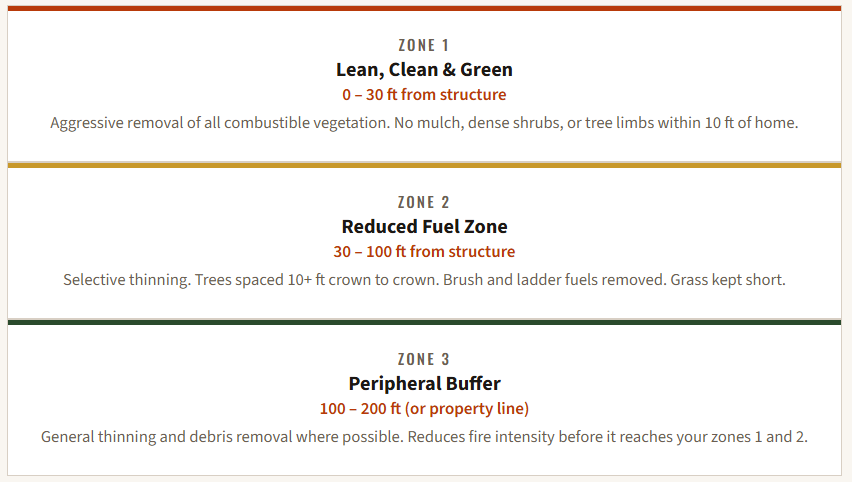
Did You Know? Colorado Law & Defensible Space
Several Southwest Colorado counties have adopted defensible space ordinances that require property owners in designated wildfire hazard areas to maintain cleared zones around structures. La Plata County, Archuleta County, and the City of Durango all have fire mitigation requirements that may apply to your property. Failure to comply can result in fines and, more importantly, increase your risk. Fire Guard LLC can help you understand and meet local requirements.
Why Land Clearing Is Especially Critical in Southwest Colorado
Southwest Colorado faces a confluence of wildfire risk factors that make proactive land clearing advisable and urgent:
Mountain Pine Beetle Epidemic
The mountain pine beetle has devastated ponderosa and lodgepole pine stands across the San Juan National Forest and surrounding private lands. Dead standing trees (grey, dry, and stripped of moisture) represent catastrophic fire fuel. A single beetle-killed tree can drop flaming bark and needles far downwind, spreading fire across properties in minutes. Land clearing that prioritizes beetle-kill removal is one of the highest-impact investments a Southwest Colorado property owner can make.
Drought-Stressed Vegetation
Colorado's persistent drought cycles have stressed nearly every plant community in Southwest Colorado. Stressed trees produce less resin and sap (their natural fire retardant) and become increasingly flammable. Even living trees in drought conditions burn faster and hotter than healthy trees in a wetter climate. This makes maintaining open, spaced vegetation through land clearing even more important than it would be in less arid regions.
Wind Patterns and Terrain
The terrain of Southwest Colorado (canyons, ridgelines, south-facing slopes, and the transitions between mesa tops and forested mountain slopes) creates wind channels that can drive fire unpredictably. The Animas River valley, the La Plata Mountains, and the Piedra River corridor all have documented fire behavior patterns that can produce rapid fire spread. Land clearing that extends upslope and into wind-exposed positions provides critical additional protection.
Growing WUI Development
Communities like Ouray, Telluride, Norwood, Ridgway, and Montrose have seen significant residential development in the wildland-urban interface over the past two decades. More homes in fire-prone terrain means more ignition risk, and neighborhoods where one property's uncleared vegetation can threaten neighbors. Land clearing is both a personal protection strategy and a community responsibility.
What Wildfire Risk Tools Tell Us About Southwest Colorado
Modern wildfire risk assessment tools like Zonehaven, Firescope, and the USFS Wildfire Hazard Potential (WHP) mapping system are used to predict risk, model fire behavior, and prioritize mitigation. What do these tools consistently show for Southwest Colorado?
La Plata County, Archuleta County, and Montezuma County all contain significant swaths of land rated Very High or Extreme on the USFS Wildfire Hazard Potential map. Areas east and north of Durango, the communities around Vallecitos, and the forested slopes above Pagosa Springs rank among the highest-risk zones in the state. Insurance risk models from companies like Verisk and Cape Analytics are increasingly flagging Southwest Colorado properties for elevated premiums, or outright coverage denial, based on vegetation density and defensible space assessments conducted via satellite imagery and machine learning.
The practical implication: land clearing that creates measurable, visible defensible space. It's increasingly a financial necessity, affecting your insurability, your property value, and your community's emergency response options. Fire Guard LLC has all of the tools and resources to help protect your home.
Want to see Where Your Home is on the Map? Click the Button Below to Learn More
Why Fire Guard Colorado?

When it comes to protecting your home from wildfire, experience matters. Fire Guard Colorado is owned and operated by Sam Tyler, a certified Fire Mitigation Specialist with a Degree in Fire Science and five years of wildland fire experience. His background on the fire line gives him firsthand knowledge of how wildfires spread and what actually helps firefighters defend homes.
Sam also continues to serve in the fire service, with five years at the Telluride Fire Protection District and eight years with the Ouray Fire Department. That experience gives him a deep understanding of wildfire behavior in Colorado’s mountain environments.
With Fire Guard Colorado, you’re not just hiring someone to clear brush. You’re working with a trained fire professional who understands what firefighters need to protect a home during a wildfire.
Fire Guard LLC provides professional land clearing and defensible space services throughout Southwest Colorado: We are typically found in Ouray, Ridgway, Norwood, Telluride, Mountain Village, Montrose & Delta. Our extended service area now includes La Plata County (Durango, Bayfield, Ignacio, and Hesperus), Archuleta County (Pagosa Springs, Pagosa Lakes, Arboles, and Chimney Rock), Montezuma & Dolores Counties (Cortez, Dolores, and Mancos) San Juan County (Silverton and surrounding high-country areas). Willing to travel beyond these regions for specialized projects.
We work on residential lots, multi-acre parcels, ranch land, HOA common areas, commercial properties, and acreage being prepared for construction or recreational development.
Frequently Asked Questions: Land Clearing in Southwest Colorado
-
Most residential lots (0.5–5 acres) can be cleared in one to three days depending on vegetation density, slope, and access. Larger acreages and commercial properties are assessed and scheduled accordingly. We'll give you a realistic timeline during your free site visit.
-
Permit requirements vary by county, municipality, and project scope. In many cases, wildfire mitigation land clearing is exempt from standard grading permits. However, work near waterways, wetlands, or on slopes above certain grades may have additional requirements. Fire Guard LLC is familiar with local regulations across Southwest Colorado and can help you navigate the process.
-
Done well, land clearing actually enhances your property. Opening up overgrown areas reveals views, creates usable outdoor space, and lets healthy trees thrive without competition. Our team takes a thoughtful approach removing what creates risk while preserving the natural character of your land.
-
Increasingly, yes. Insurance carriers are using aerial and satellite imagery to assess defensible space. Properties with demonstrated fuel reduction and cleared zones around structures are being rewarded with better coverage terms. Some carriers specifically list vegetation management as a factor in wildfire risk scoring. We can provide documentation of work completed for your insurance carrier.
-
Yes. Vegetation regrows, and a single clearing is not a permanent solution. Fire Guard LLC offers annual and seasonal maintenance programs to keep your defensible space current, so you're protected year after year without having to start from scratch each time.