

Ladder Fuel Removal in Southwest Colorado: Breaking the Path From Ground Fire to Crown Fire
By Fire Guard LLC |
Crown Fire Prevention | Residential & Commercial | Limbing Up Trees | Free Estimates
Of all the wildfire mitigation services Fire Guard LLC provides, ladder fuel removal may be the most misunderstood and one of the most important. Most homeowners worry about fire on the ground. But in Southwest Colorado's pine and mixed-conifer forests, the real catastrophe begins when a surface fire gets access to the canopy. Ladder fuel removal stops that from happening.
What Are Ladder Fuels and Why Do They Matter?
A ladder fuel is any combination of vegetation that creates a vertical connection between fire burning on the forest floor and the tree canopy overhead. Picture a forest scene: grasses and pine needles burn at ground level. Nearby, low-hanging tree branches dip to within a few feet of the ground. A dense shrub grows against the trunk. Small trees and saplings crowd under the larger pines. Each of these elements, individually manageable, forms a ladder fuel when they occur together.
When a surface fire reaches a ladder fuel sequence, it climbs. In seconds, fire that might have been controlled as a low-intensity ground fire instead ignites the tree crown. Once crown fire begins, it generates its own wind and fire behavior, spreads through the canopy at speeds that can outrun a person, and produces a rain of burning embers that can carry ignition spots hundreds of feet ahead of the main fire front.
“Crown fires destroy homes. Ladder fuels are what allow them to start. Removing ladder fuels is one of the most effective wildfire mitigation actions available to property owners in forested Colorado communities.”
What Our Ladder Fuel Removal Service Can Includes
Fire Guard LLC's land clearing service is comprehensive. Each project varies based on the property, homeowner preferances, and insurance needs. Every project has the option to include:
Limbing Up (Raising the Crown Base)
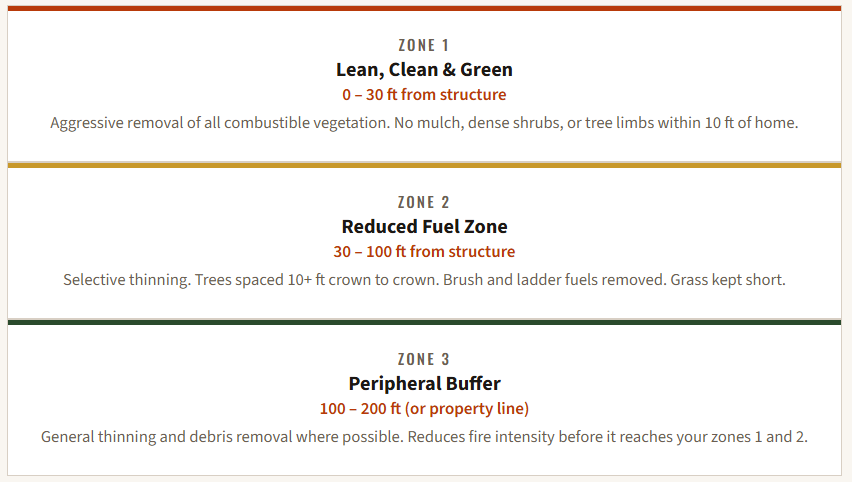
The foundation of ladder fuel removal is called limbing up, which means to remove the lower branches of trees to raise the base of the living canopy. The Colorado State Forest Service recommends a minimum of 6 feet of clearance in Zone 1 (0–30 ft from structures) and ideally 10 feet in Zone 2 (30–100 ft). On steeper slopes, where fire travels more aggressively uphill, even greater clearance may be warranted. Our team can perform clean, professional cuts that heal quickly and don't compromise tree health.
Shrub and Understory Removal
Gambel oak, serviceberry, snowberry, mahonia, and young conifer saplings are the most common ladder fuel contributors in Southwest Colorado's ponderosa pine and mixed-conifer forests. We can strategically remove shrubs and understory plants in areas where they create vertical continuity with the tree canopy. This is a selective process not all understory vegetation is removed, just what creates fire hazard.
Small Tree and Sapling Management
Young trees growing beneath the canopy of larger trees are one of the most overlooked ladder fuel hazards. A 10-foot-tall sapling growing against the trunk of a 50-foot ponderosa pine effectively eliminates any gap between ground fire and the canopy. We can identify and remove high-risk small trees and saplings, particularly those in direct proximity to large mature trees and structures.
Debris Clearing at Base of Trees
Deep needle duff, bark piles, and accumulated debris at the base of trees create intense heat and fire duration right where the flame-to-trunk contact matters most. We clear this material from tree bases, reducing the possibility that even a brief contact from ground fire will ignite the trunk and climb to the crown.
Understanding Defensible Space Zones in Colorado
The Colorado State Forest Service defines defensible space using a zone-based model. Land clearing plays a critical role in each zone. Fire Guard LLC is experienced in designing and executing clearing plans that satisfy all three zones, tailored to your specific property topography, vegetation type, and local code requirements.
Did You Know? Colorado Law & Defensible Space
Several Southwest Colorado counties have adopted defensible space ordinances that require property owners in designated wildfire hazard areas to maintain cleared zones around structures. La Plata County, Archuleta County, and the City of Durango all have fire mitigation requirements that may apply to your property. Failure to comply can result in fines and increase your risk. Fire Guard LLC can help you understand and meet local requirements.
The Ladder Fuel Problem in Southwest Colorado's Forests
Southwest Colorado faces a confluence of wildfire risk factors that make proactive land clearing not just advisable and urgent:
Ponderosa Pine and Mixed Conifer Stands
The ponderosa pine forests dominant throughout La Plata County, Archuleta County, and the San Juan National Forest are naturally ladder-fuel-prone environments. Pre-settlement fire ecology in these forests featured frequent, low-intensity surface fires, naturally occurring ground fires that cleared understory, thinned small trees, and maintained open, park-like forest structure. Fire suppression over the past century has allowed understory vegetation to accumulate dramatically, creating today's dense, ladder-fuel-rich conditions throughout the region.
Beetle Kill and Dry Fuels
Mountain pine beetle-killed trees throughout Southwest Colorado are standing ladder fuel. As beetle-killed trees shed their needles and bark, the debris accumulates at the base of the trunk in exactly the kind of fine-fuel concentration that allows ground fires to find access points to the dead wood column above. Combined with the dry, resinous timber of the dead tree itself, beetle-kill trees are extraordinarily effective fire ladder fuels. Targeting these trees for removal or aggressive limbing up is a cornerstone of our ladder fuel work in the region.
Canyon and Slope Amplification
Southwest Colorado's dramatic topography (particularly in the Animas Canyon, the Florida River drainage, the Piedra corridor, and along the La Plata Mountains foothills) creates terrain where upslope fire spread is dramatically accelerated. Fire traveling up a 30% slope moves approximately four times faster than fire on flat ground. In steep terrain, the effective height of ladder fuels is magnified: a 6-foot shrub on a 40% slope may present fire behavior equivalent to a 15-foot shrub on flat ground. Our team accounts for slope and aspect in every ladder fuel assessment.
Wildfire Models and Ladder Fuel Risk in Southwest Colorado
Modern wildfire risk assessment tools like Zonehaven, Firescope, and the USFS Wildfire Hazard Potential (WHP) mapping system are used to predict risk, model fire behavior, and prioritize mitigation. What do these tools consistently show for Southwest Colorado?
La Plata County, Archuleta County, and Montezuma County all contain significant swaths of land rated Very High or Extreme on the USFS Wildfire Hazard Potential map. Areas east and north of Durango, the communities around Vallecitos, and the forested slopes above Pagosa Springs rank among the highest-risk zones in the state. Insurance risk models from companies like Verisk and Cape Analytics are increasingly flagging Southwest Colorado properties for elevated premiums, or outright coverage denial, based on vegetation density and defensible space assessments conducted via satellite imagery and machine learning.
The practical implication: land clearing that creates measurable, visible defensible space. It's increasingly a financial necessity, affecting your insurability, your property value, and your community's emergency response options. Fire Guard LLC has all of the tools and resources to help protect your home.
Want to see Where Your Home is on the Map? Click the Button Below to Learn More
Why Fire Guard Colorado?

When it comes to protecting your home from wildfire, experience matters. Fire Guard Colorado is owned and operated by Sam Tyler, a certified Fire Mitigation Specialist with a Degree in Fire Science and five years of wildland fire experience. His background on the fire line gives him firsthand knowledge of how wildfires spread and what actually helps firefighters defend homes.
Sam also continues to serve in the fire service, with five years at the Telluride Fire Protection District and eight years with the Ouray Fire Department. That experience gives him a deep understanding of wildfire behavior in Colorado’s mountain environments.
With Fire Guard Colorado, you’re not just hiring someone to clear brush. You’re working with a trained fire professional who understands what firefighters need to protect a home during a wildfire.
Fire Guard LLC provides professional ladder fuel removal and defensible space services throughout Southwest Colorado: We are typically found in Ouray, Ridgway, Norwood, Telluride, Mountain Village, Montrose & Delta. Our extended service area now includes La Plata County (Durango, Bayfield, Ignacio, and Hesperus), Archuleta County (Pagosa Springs, Pagosa Lakes, Arboles, and Chimney Rock), Montezuma & Dolores Counties (Cortez, Dolores, and Mancos) San Juan County (Silverton and surrounding high-country areas). Willing to travel beyond these regions for specialized projects.
We work on residential lots, multi-acre parcels, ranch land, HOA common areas, commercial properties, and acreage being prepared for construction or recreational development.
Frequently Asked Questions: Ladder Fuels in Southwest Colorado
-
These services address different dimensions of fire risk and are often performed together. Tree thinning reduces the horizontal density of trees spacing them further apart to limit fire spread through the canopy. Ladder fuel removal addresses the vertical dimension eliminating the connection between ground fire and the canopy. A properly thinned but unmanaged stand can still have significant ladder fuel hazard. Both are part of a complete mitigation plan.
-
Low shrubs and understory plants regrow, and trees develop new low branches over time. For most Southwest Colorado properties, revisiting fuel ladder removal every 2–4 years is appropriate. Fire Guard LLC offers maintenance programs so you don't have to think about it we'll proactively reach out to schedule visits to keep your ladder fuels controlled year after year.
-
Some homeowners do perform their own limbing up on accessible, smaller trees. However, safe and effective ladder fuel removal on larger trees and steeper terrain requires professional equipment and training. Improper cuts can damage trees and create new hazards. For a thorough, defensible-space-compliant result, professional service is strongly recommended especially in the forested, steep terrain common throughout Southwest Colorado.